Launch offer — valid today only

📄 Digital book in PDF · read it on your phone or print it

The Pump Installer Exam in Drawings: Work TDH, Precharge and 3-Wire Ohms Step by Step One Topic on Every Page

For the pump installer exam and for the field, not for beginners: well construction, pitless adapters, submersible and jet pumps, TDH, pressure tanks, control boxes, drop cable and multimeter troubleshooting. Each topic on its own page: the drawing first, then the numbers and steps to remember. 66 illustrated pages.

YES, I WANT THE ILLUSTRATED BOOK

🔒 Secure checkout · PDF by email · 30-day guarantee

Every topic, its own pageEvery part and every calculation drawn, with the explanation right beside it
66 illustrated pages9 parts, from the aquifer to the field checklist
Up-to-date sourcesChecked against NGWA exam content areas, NEC Articles 250 and 430 and EPA private well guidance
PDF by emailFormat

Look Inside the Book

Every page has a large drawing and a box with the numbers and steps you need to know:

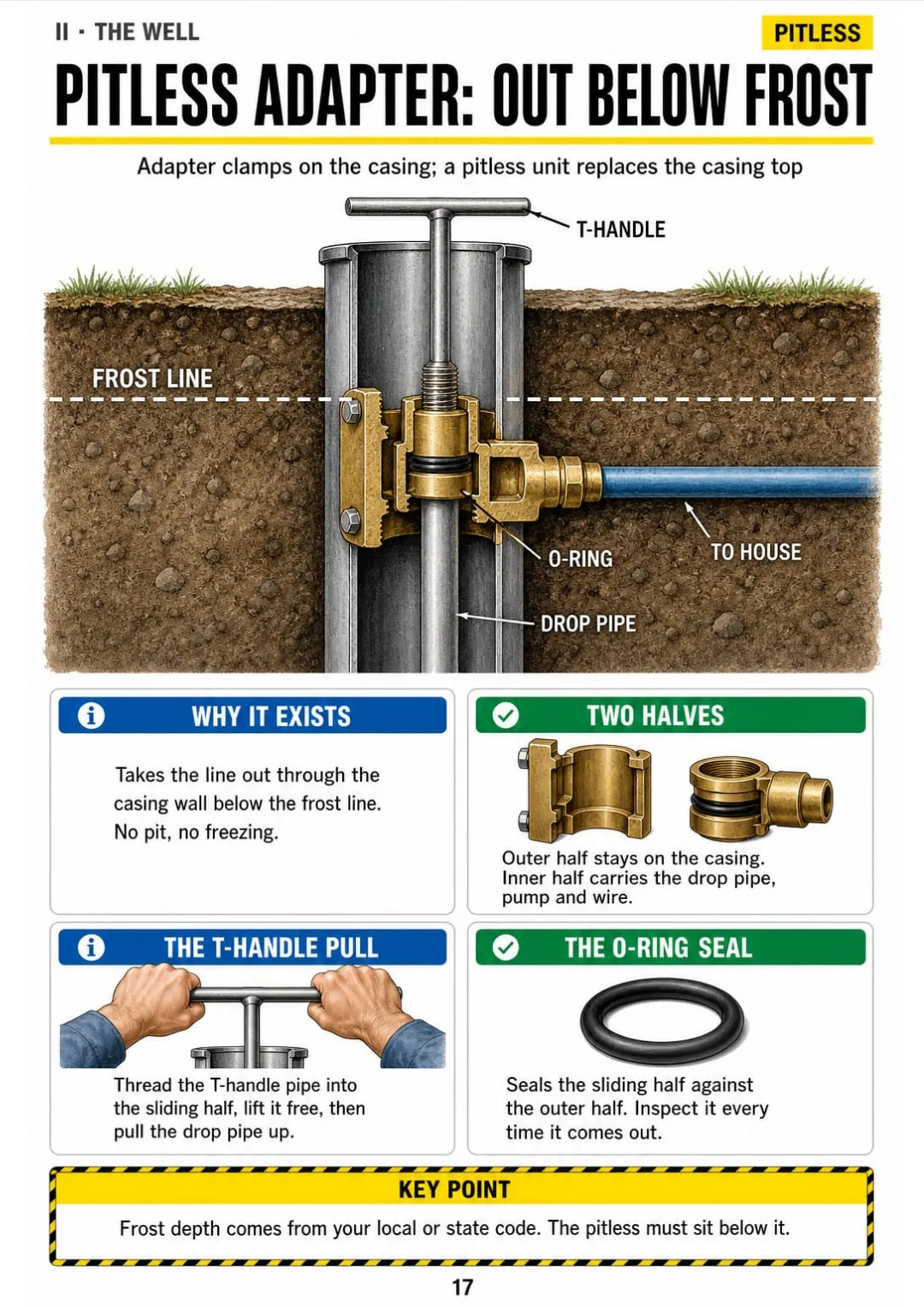
The pitless adapter exits below the frost line; the drop pipe hangs from its O-ring-sealed slide.
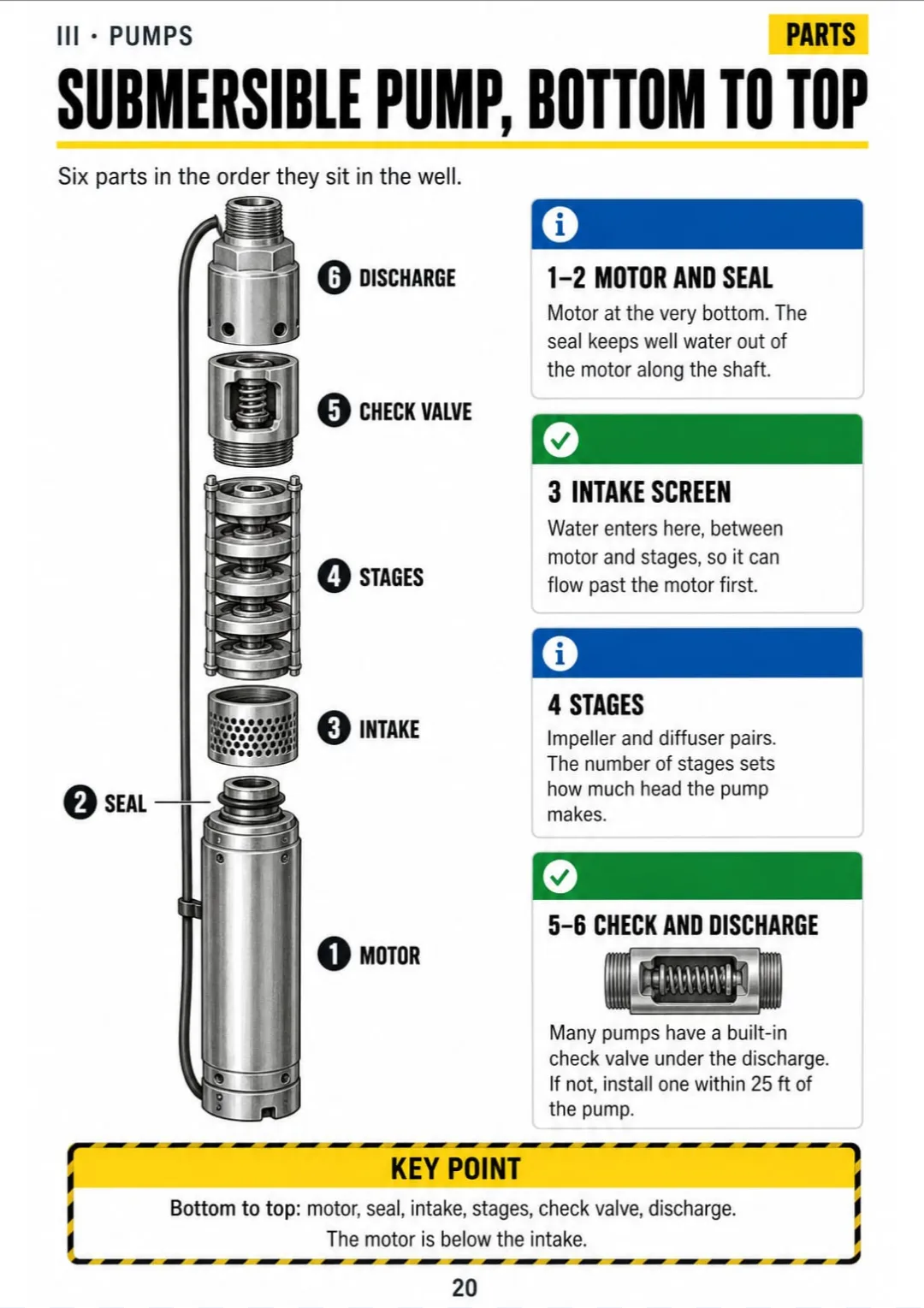
Motor · seal · intake screen · stages · check valve · discharge: bottom to top.
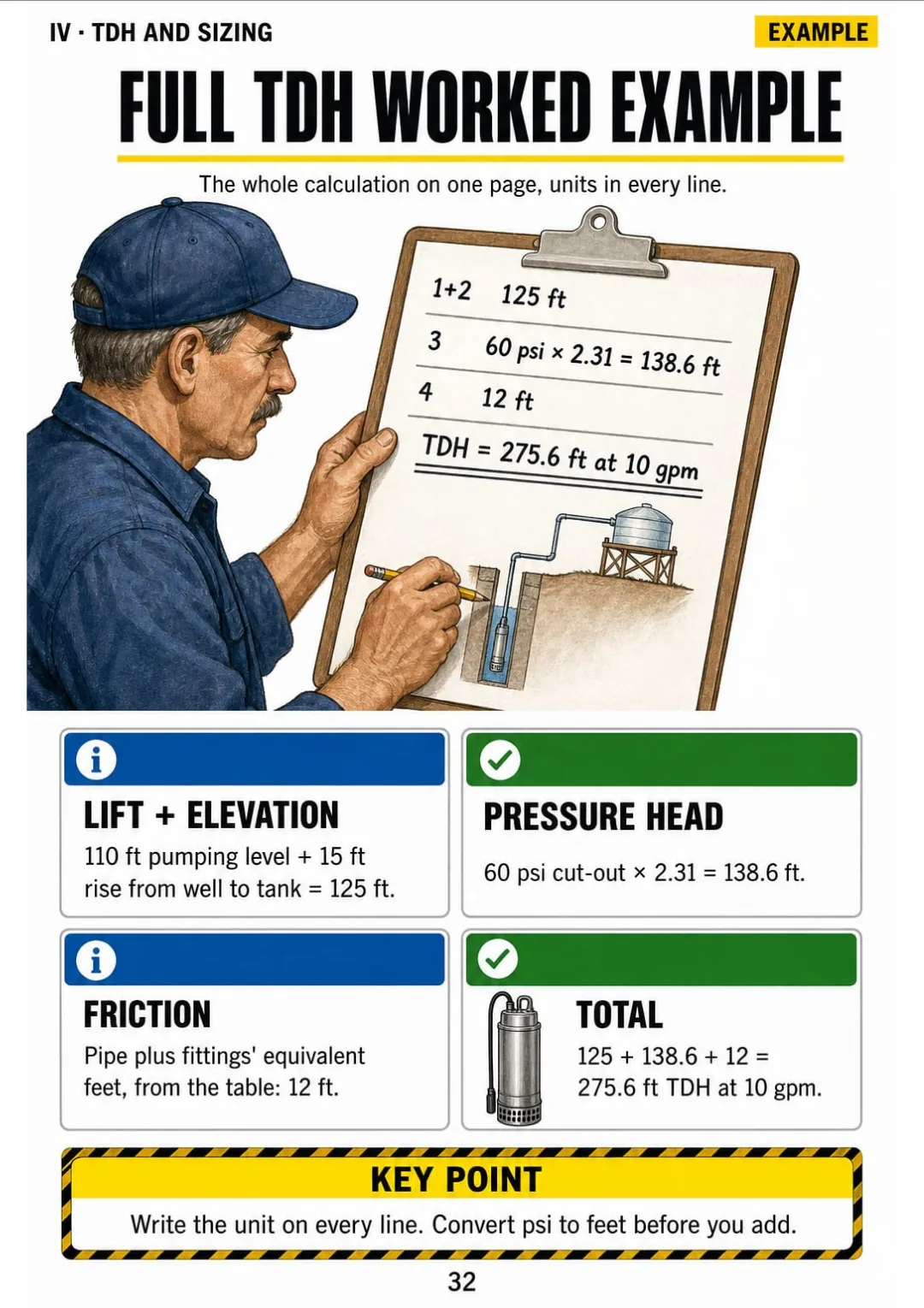
125 ft + 138.6 ft + 12 ft = 275.6 ft TDH at 10 gpm
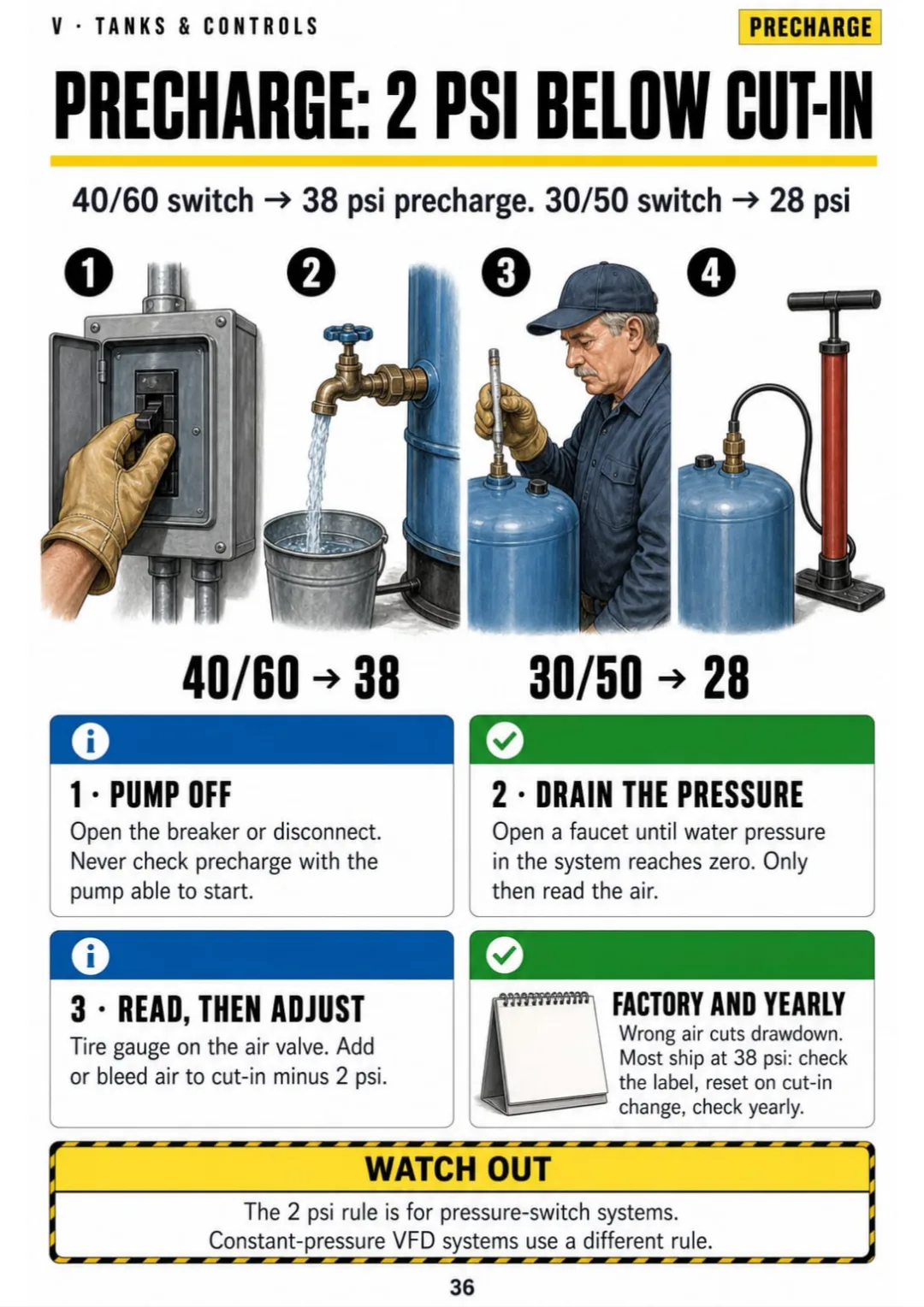
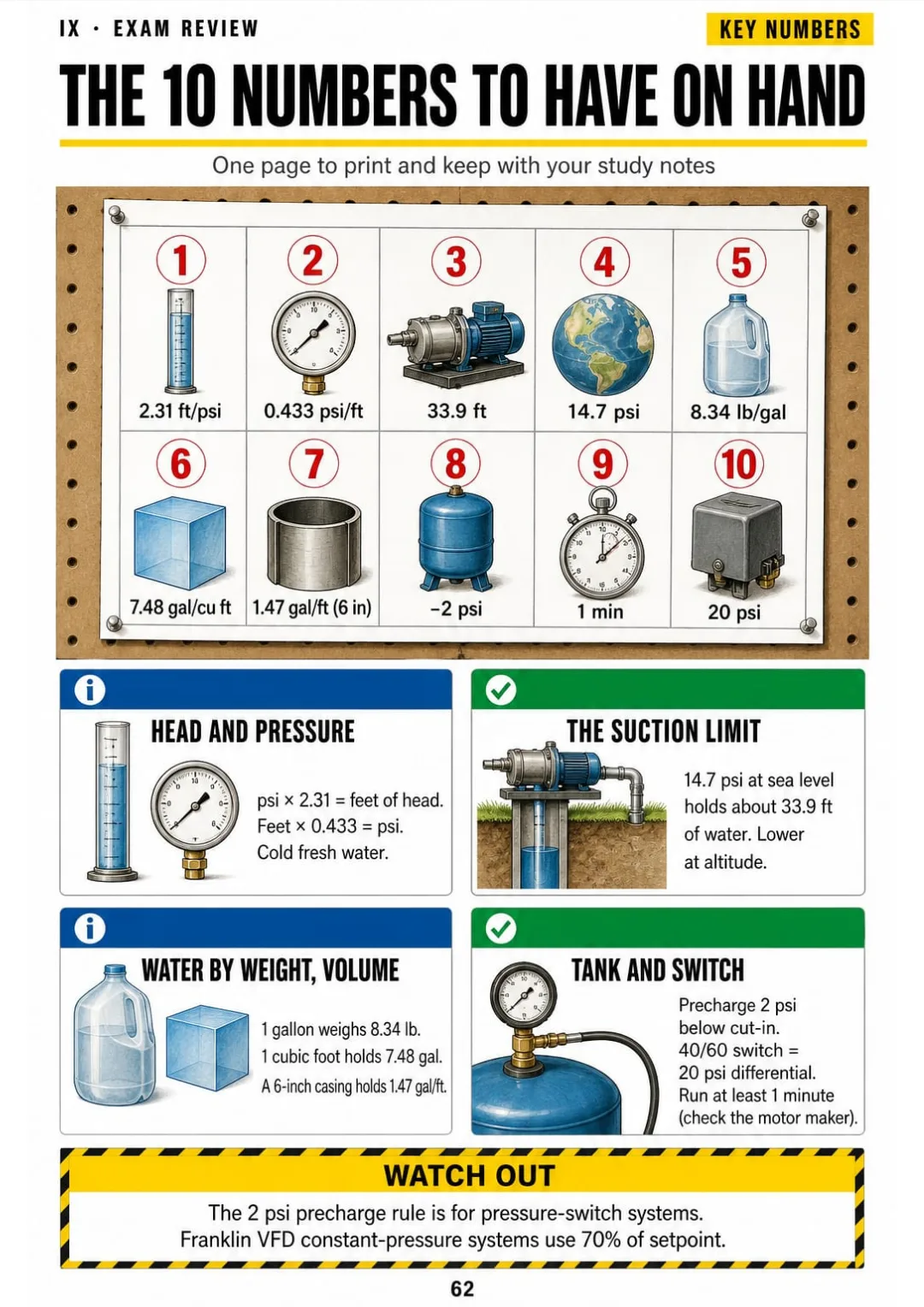
Precharge = cut-in − 2 psi: 40/60 → 38 psi, 30/50 → 28 psi
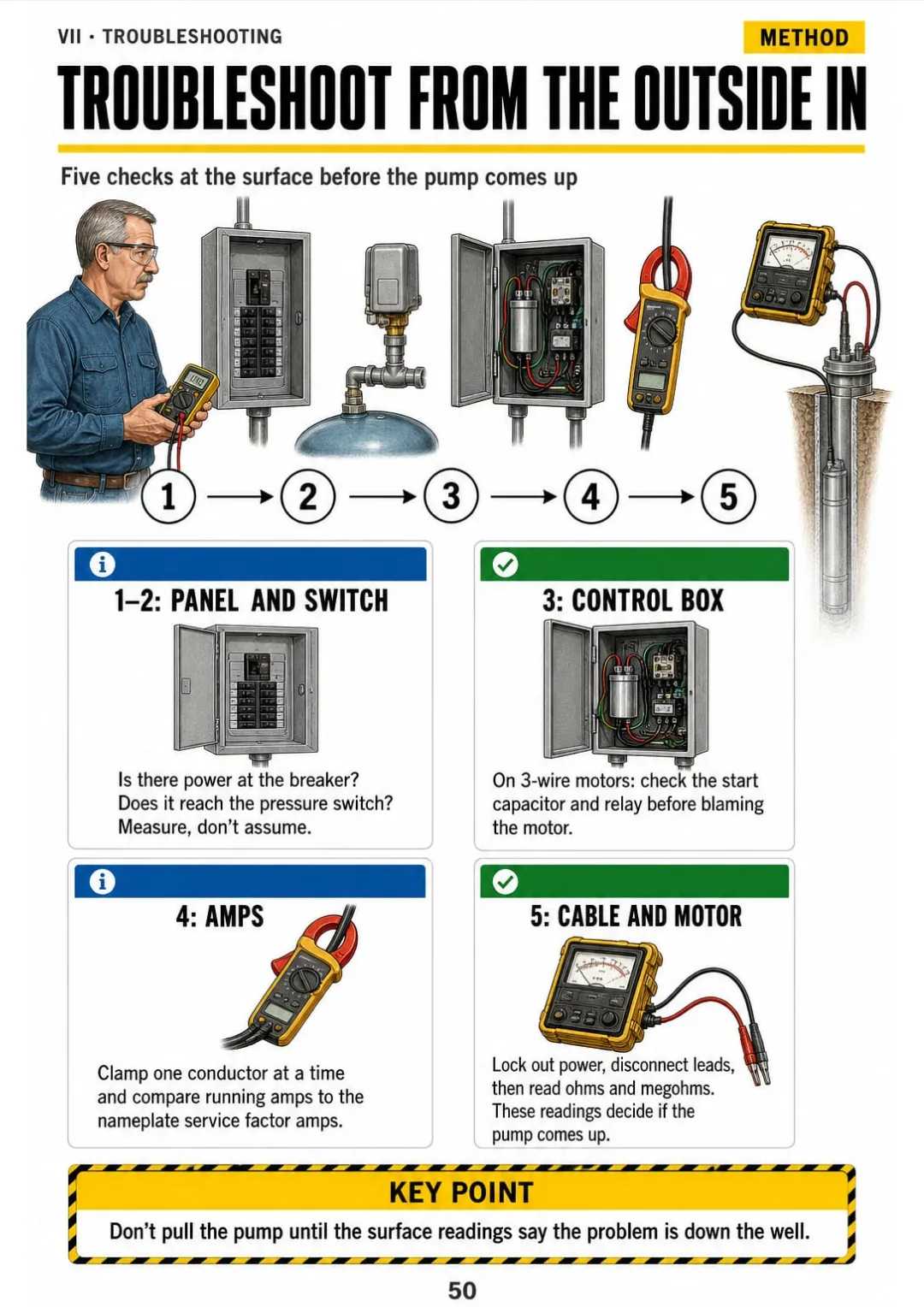
Panel → pressure switch → control box → amps → ohms and megohms. Pull the pump last.
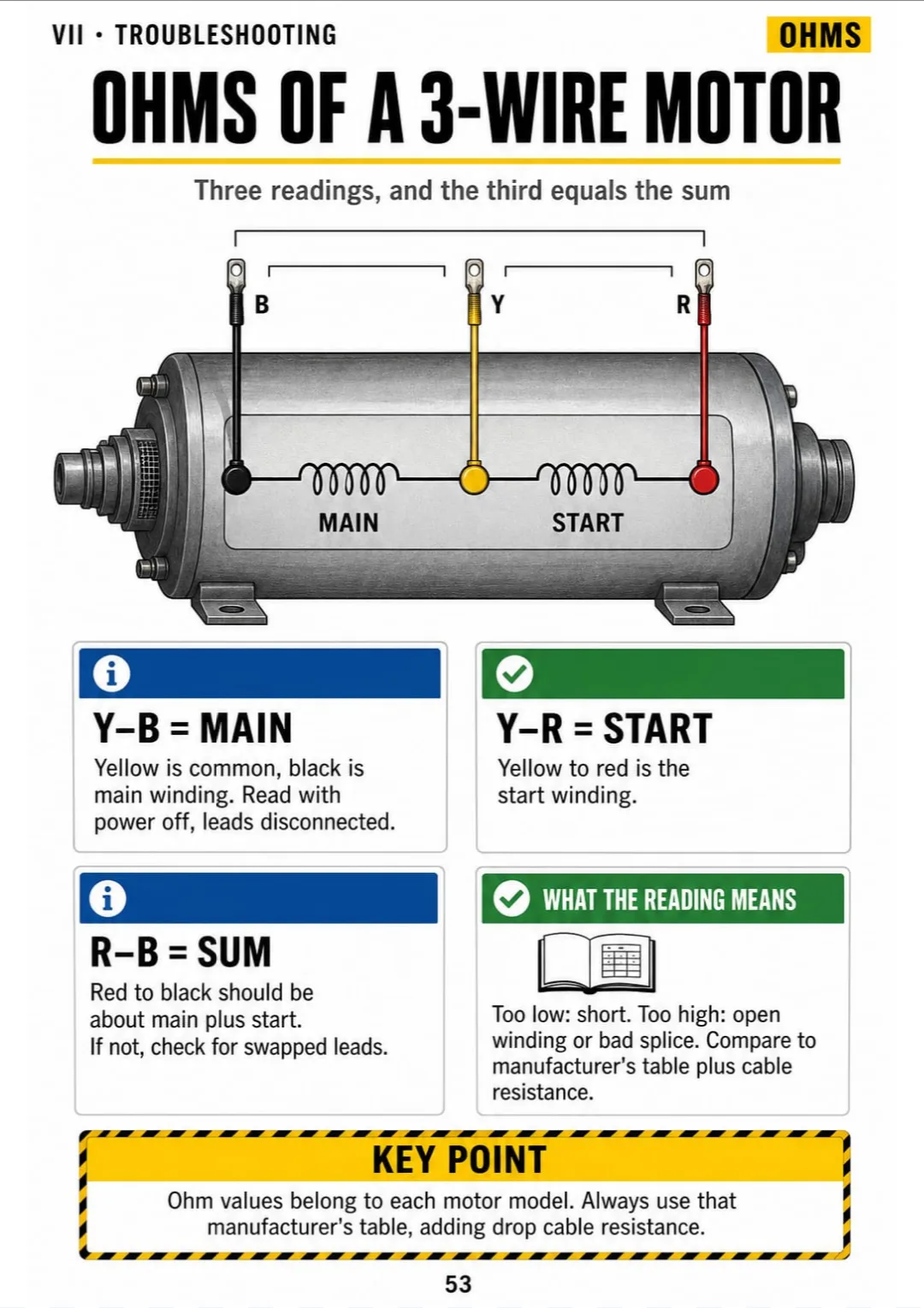
3-wire motor: Y–B main, Y–R start, R–B ≈ the sum of both.
2.31 ft per psi, 33.9 ft suction limit, precharge 2 psi below cut-in: the 10 numbers on one page
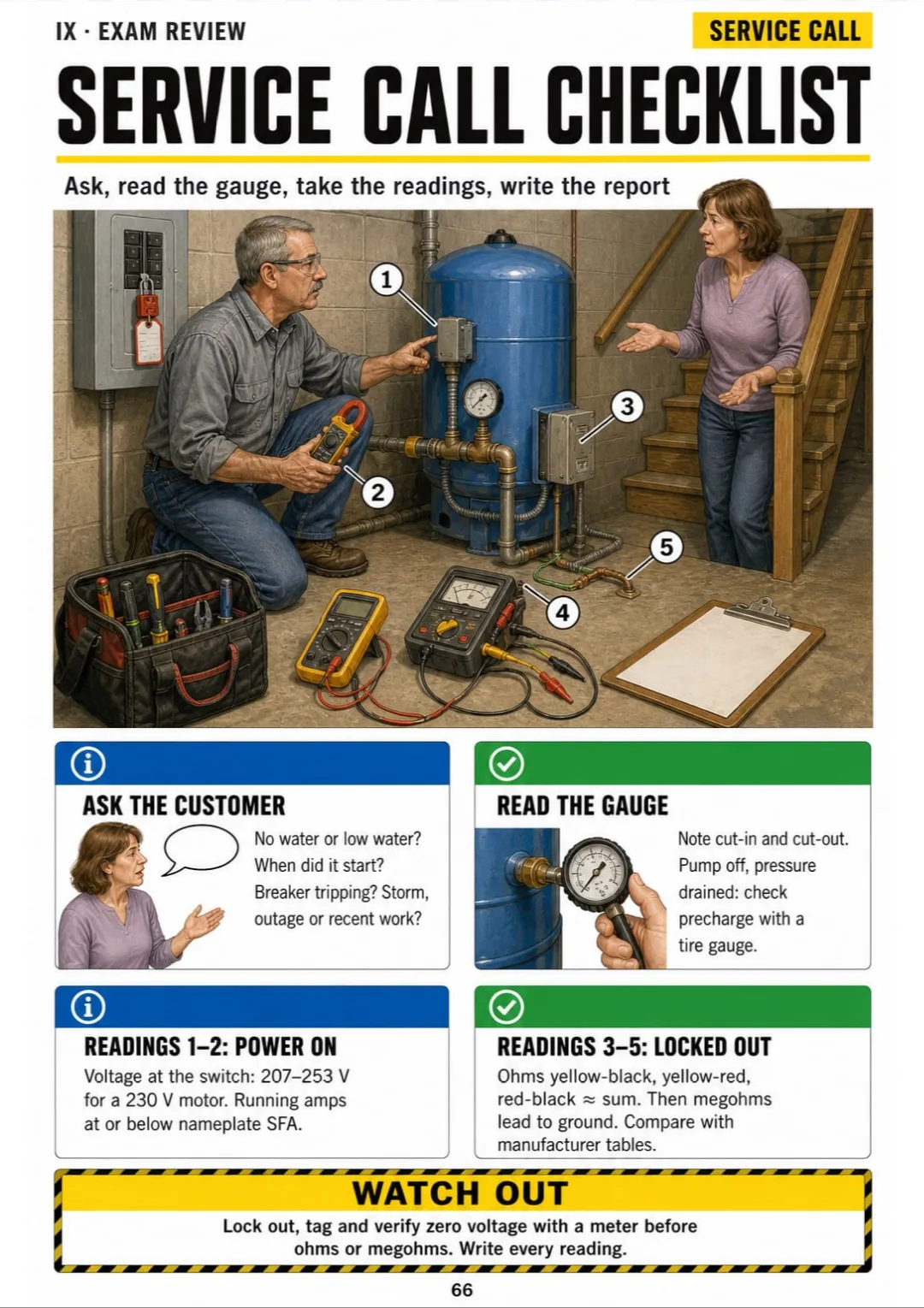
Voltage, amps, ohms and megohms in order: 207–253 V for a 230 V motor before anything else

Swipe to see more →

These are real pages from the book. The table of contents is the full one: 9 parts and 62 topics.

The Problem Isn't You. It's How It Was Explained to You.

You're looking at an exam question: 125 feet to the pumping level, 60 psi at cut-out, 10 gpm through the drop pipe. Find the total dynamic head.

You've done this on real jobs. But the manual explains it in paragraphs: lift, then pressure head, then a friction table three pages later. By the time you get to the answer, you've lost the order.

125 ft + 138.6 ft + 12 ft = 275.6 ft TDH at 10 gpm

In the book, that same example is one drawing: the well, the pipe and the tank, with each piece of head stacked beside it. 125 ft of lift + 138.6 ft of pressure head (60 psi × 2.31) + 12 ft of friction from the table = 275.6 ft at 10 gpm, added in the same order every time.

And it's not just TDH. Precharge, the pitless adapter, the submersible pump bottom to top, 3-wire motor ohms and troubleshooting from the outside in: each one has its own page.

So when the question shows up with numbers, you picture the drawing, follow the steps and work it out without going back to the manual.

COMPARE FOR YOURSELF

Same Topic, Two Ways to Study It

THIS
  • The manual: line after line of text
  • Pump parts explained only in words
  • You show up to the exam still unsure
The submersible pump assembly consists of a sealed electric motor coupled to a multistage centrifugal pump end. The motor, positioned at the lowest point of the assembly, is protected by a shaft seal that prevents the entry of well water into the motor cavity. Above the seal, water enters through the intake screen and is progressively pressurized by a series of impeller and diffuser stages, the number of which determines the developed head, before passing through the integral check valve and the discharge connection to the drop pipe.
FOR THIS
  • The submersible pump in one drawing
  • The parts, bottom to top, in a box
  • You see it and it clicks
Motor · seal · intake screen · stages · check valve · discharge: bottom to top.
CONTENTS

Take a Look at the 9 Parts and 62 Topics

The system as one path, the well itself, submersible and jet pumps, TDH and sizing, tanks and controls, wiring and the NEC, multimeter troubleshooting, disinfection and safety, and the exam review: 66 pages, all illustrated

IThe System as One Path · pp. 5-11
  1. From Aquifer to Faucet: The Whole System in One Drawing
  2. Static Level, Pumping Level, Drawdown
  3. Feet of Head vs. psi: The Number You Can't Forget
  4. Atmospheric Pressure and Why Suction Has a Limit
  5. Flow (gpm) vs. Pressure (psi): Two Different Questions
  6. Units and Abbreviations on the Exam
  7. Reading Your State Code Next to the NEC
IIThe Well Itself · pp. 12-18
  1. Aquifers: Confined, Unconfined, Flowing
  2. Casing, Annular Seal and Grout
  3. Screens and Open-Hole Wells
  4. Casing Volume per Foot
  5. The Wellhead: Cap, Vent and Height Above Grade
  6. Pitless Adapter and Pitless Unit
  7. Well Yield and Specific Capacity
IIIPumps: Submersible and Jet · pp. 19-26
  1. How a Centrifugal Impeller Makes Head
  2. Submersible Pump: Parts from Bottom to Top
  3. Motor Cooling: Flow Past the Motor
  4. Setting Depth: Below Pumping Level, Above the Bottom
  5. Shallow-Well Jet Pump
  6. Deep-Well (Two-Pipe) Jet Pump
  7. Drop Pipe, Torque Arrestor and Safety Rope
  8. Check Valves: Where and How Many
IVTDH and Pump Sizing · pp. 27-34
  1. TDH in 4 Fixed Steps
  2. Step 1–2: Vertical Lift
  3. Step 3: Pressure Head at Cut-Out
  4. Step 4: Friction Loss in Pipe
  5. Fittings and Equivalent Length
  6. Full TDH Worked Example
  7. Reading a Pump Curve
  8. Household Demand: How Many gpm
VPressure Tanks and Controls · pp. 35-42
  1. How a Captive-Air Tank Works
  2. Precharge: 2 psi Below Cut-In
  3. Drawdown Is Not Tank Size
  4. Sizing the Tank for Run Time
  5. Short Cycling: Causes and Damage
  6. Pressure Switch: Cut-In, Cut-Out, Differential
  7. Tank Tee, Gauge, Relief Valve, Drain
  8. Constant Pressure Systems with a VFD
VIWiring and the Electrical Code · pp. 43-49
  1. 2-Wire vs. 3-Wire Submersible Motors
  2. The Control Box: Start Capacitor and Relay
  3. Sizing Drop Cable by Length
  4. Waterproof Splices
  5. Grounding the Pump Circuit
  6. Disconnect, Overload and Motor Rules
  7. Lockout/Tagout Before You Touch It
VIITroubleshooting with a Multimeter · pp. 50-56
  1. The Troubleshooting Order: Outside In
  2. Checking Voltage at the Pressure Switch
  3. Amp Draw vs. Nameplate
  4. Resistance (Ohms) of Motor Windings
  5. Insulation Resistance with a Megohmmeter
  6. No Water vs. Low Water
  7. Breaker Trips the Moment the Pump Starts
VIIIDisinfection, Water Quality and Safety · pp. 57-61
  1. Shock Chlorination Dose: The Formula
  2. Shock Chlorination Step by Step
  3. Bacteria Testing and When to Test
  4. Iron, Sulfur Smell, Sediment
  5. Lifting, Rigging and Working Over an Open Well
IXExam Review and Field Checklist · pp. 62-66
  1. The 10 Numbers to Have on Hand
  2. The Formulas on One Page
  3. Frequent Mistakes in Exam Calculations
  4. New Install Checklist
  5. Service Call Checklist

One Page, One Topic, All Clear

Think of it this way:

A customer calls: the pump kicks on every 20 seconds. You're at the tank with a tire gauge and you need the precharge number right now.

You open the book to the precharge page and see the tank drawn with its air side and its water side: cut-in minus 2 psi. A 40/60 switch gets 38 psi, a 30/50 gets 28.

Panel → pressure switch → control box → amps → ohms and megohms. Pull the pump last.

Same with the pitless adapter, TDH, the control box, 3-wire motor ohms and the megohm test: each one on its own page, drawn.

Well Pump Installer Illustrated is 9 parts and 62 topics, all drawn, and at the end the 10 numbers to have on hand, the formulas on one page and two field checklists.

What you see drawn, you don't have to memorize.

What's Inside Well Pump Installer Illustrated:

Ipp. 5-11

The System as One Path

The whole system from aquifer to faucet, static and pumping level, drawdown, feet of head vs. psi, the suction limit, gpm vs. psi and the units on the exam.

IIpp. 12-18

The Well Itself

Confined and unconfined aquifers, casing, annular seal and grout, screens, casing volume per foot, the wellhead, the pitless adapter and well yield.

IIIpp. 19-26

Pumps: Submersible and Jet

How an impeller makes head, the submersible pump from bottom to top, motor cooling, setting depth, shallow and deep-well jet pumps, drop pipe and check valves.

IVpp. 27-34

TDH and Pump Sizing

Work any TDH question in 4 fixed steps: vertical lift, pressure head, friction loss and fittings, then a full worked example, reading a pump curve and household demand in gpm.

Vpp. 35-42

Pressure Tanks and Controls

How a captive-air tank works, precharge, drawdown vs. tank size, run time, short cycling, the pressure switch, the tank tee and constant pressure with a VFD.

VIpp. 43-49

Wiring and the Electrical Code

2-wire vs. 3-wire motors, the control box, drop cable by length, waterproof splices, grounding, disconnect and overload rules, and lockout/tagout.

VIIpp. 50-56

Troubleshooting with a Multimeter

Find the fault before you pull anything: the outside-in order, voltage at the pressure switch, amps vs. nameplate, winding ohms, megohm testing, no water vs. low water and the breaker that trips at start.

VIIIpp. 57-61

Disinfection, Water Quality and Safety

Shock chlorination dose and steps, bacteria testing, iron, sulfur smell and sediment, and working safely over an open well.

IXpp. 62-66

Exam Review and Field Checklist

The 10 numbers to have on hand, the formulas on one page, frequent calculation mistakes and the new install and service call checklists.

At the end of the book: The 10 key numbers, all formulas on one page, frequent calculation mistakes and two field checklists.


Plus: 2 Free Books

Pump Installer Practice Questions: Exam-Style Questions with Every Answer Explained

BONUS 1: «Pump Installer Practice Questions: Exam-Style Questions with Every Answer Explained»

Value on its own: US$ 17.90

Practice the way the exam asks it, with numbers, and see on the drawing why each answer is right.

The 15 Most Common Well Pump Mistakes, Before & After

BONUS 2: «The 15 Most Common Well Pump Mistakes, Before & After»

Value on its own: US$ 14.90

See the wrong setup next to the right one, from check valve placement to tank precharge, so you spot it on the job.

Well Pump Installer Illustrated with 2 Free Books

  • Well Pump Installer Illustrated: 66 illustrated pagesUS$ 63
  • BONUS 1: Pump Installer Practice Questions: Exam-Style Questions with Every Answer ExplainedUS$ 17.90
  • BONUS 2: The 15 Most Common Well Pump Mistakes, Before & AfterUS$ 14.90
  • High-resolution PDF to printIncluded
Total value US$ 95.80
YOUR PRICE:
US$ 27
You save US$ 68.80
YES, I WANT WELL PUMP INSTALLER ILLUSTRATED FOR US$ 27

📄 This is a digital PDF book sent to your email: nothing is printed or shipped.

Secure purchaseEncrypted payment30-day guarantee

PDF by email: We email you Well Pump Installer Illustrated as a PDF, together with the two free books. It's a single payment: no installments, no extra charges.

Who This Book Is For

You're learning the well side

You're learning the well side

Helper, plumber or electrician picking up well work: you see the whole system as one path, aquifer to faucet, and each part on its own page.

Your pump installer exam is coming up

Your pump installer exam is coming up

TDH, tank sizing and chlorination worked in fixed steps, plus practice questions with every answer explained on the drawing.

You already run service calls

You already run service calls

Print it and keep it in the truck: the troubleshooting order, the ohm and megohm readings and the 10 numbers, right where you need them.

Everything You Get Today

US$ 95.80US$ 27
YES, I WANT WELL PUMP INSTALLER ILLUSTRATED FOR US$ 27

📄 This is a digital PDF book sent to your email: nothing is printed or shipped.

30DAYS
GUARANTEE

30-Day Guarantee

Try Well Pump Installer Illustrated for 30 days, bonus books included.

We refund everything if the file won't open, if the book isn't what you see here, if you were charged twice or if the email doesn't arrive. Just email us.

You pay once. No subscriptions.

Frequently Asked Questions

Is it for me if I've been setting pumps for years?

Yes. It isn't a beginner's book: it puts what you already do in the field in one order, and adds the calculations and code points the exam asks with numbers. It also works for helpers and for plumbers or electricians taking on well work.

Where does the content come from?

It's checked against the NGWA pump installer exam content areas, the 2023 NEC (Articles 250 and 430), state well construction codes, EPA private well guidance and pump and motor manufacturers' installation data. Your state may have adopted an earlier NEC edition and has its own well rules, so every code point is marked for you to confirm against your state's current version. If your state gives its own pump installer exam, the system, the calculations and the troubleshooting order are the same.

Is this official material?

No. It's an independent study book. It isn't published, approved or endorsed by NGWA, NFPA or any state agency, and buying it doesn't give you a certificate, a license or continuing education hours. You still take the exam through your certifying body or your state.

Does it replace a course or training?

No. It's study and review material. It doesn't replace training, hands-on experience, the manufacturer's instructions or your state's code.

Are the practice questions the ones on the exam?

No. They're written for this book, in the style of the exam, with every answer explained. They aren't official exam questions.

When and how do I get it?

The book and the 2 bonus books arrive as PDFs by email, at the address you enter at checkout.

Do I have to pay every month?

No. It's a one-time payment. No subscription.

Can I have it on paper?

We don't ship a printed copy. It's a PDF, sent by email, that you can print at home or at a print shop and keep in the truck.

How does the refund work?

You have 30 days. We refund everything if the file won't open, if the book isn't what you see on this page, if you were charged twice or if the email doesn't arrive: just email us.

Before You Close This Page

No more rereading pages that don't stick.

TDH, precharge and 3-wire ohms, drawn so they finally make sense.

You walk into the exam knowing where everything is.

Drawings make studying faster.

The book is right below.

One-time payment: US$ 27 · Guarantee: 30 days · PDF by email

YES, I WANT WELL PUMP INSTALLER ILLUSTRATED FOR US$ 27

📄 This is a digital PDF book sent to your email: nothing is printed or shipped.